Asynchronous Processing
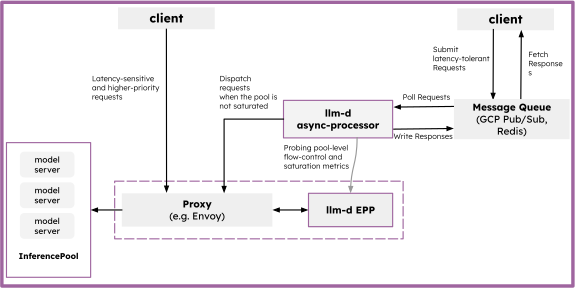
The Asynchronous Processing path enables queue-based inference for latency-insensitive workloads or for filling "slack" capacity in your inference pool. It decouples request submission from execution, allowing clients to submit large volumes of work without maintaining a long-lived HTTP connection.
Deploy
See the asynchronous processing guide for deployment instructions using Helm and supported queue implementations (Redis or GCP Pub/Sub).
Architecture
The Async Processor is a lightweight dispatch agent that pulls requests from a message queue and forwards them to the llm-d Router.
Dispatch Gating
To prevent background tasks from impacting real-time traffic, the Async Processor uses Dispatch Gates. These gates regulate the flow of requests based on system metrics:
- Prometheus Gating: Queries model server saturation (e.g., KV cache pressure, queue depth) and only dispatches when the system has available "slack" capacity.
- Budget Gating: Uses a pre-calculated budget to control throughput.
- Priority & Deadlines: Requests can be prioritized, and the processor enforces deadlines to ensure stale work is abandoned.
Resilience
- Retries: Transient failures (like rate limits or network issues) are automatically re-queued with exponential backoff.
- Concurrency Control: Configurable worker pools allow you to tune the degree of parallelism for background processing.
Use Cases
- Batch Inference: Processing large datasets where completion time is measured in minutes or hours rather than milliseconds.
- Slack Capacity Filling: Using idle GPU cycles between real-time request spikes to perform background tasks like document summarization or embedding generation.
- Offline Evaluation: Running model evaluation pipelines without competing for production resources.
Further Reading
See the Async Processor Architecture for more details on the internal mechanics.